With the sunset of Morehouse Cowles, DisperseTech now offers compatible impeller blades for legacy mixers. Customers...

Search in blog
Blog categories
Latest posts
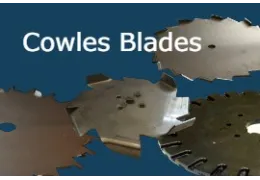
Morehouse Cowles Sunset – DisperseTech Offers Compatible Impeller Blades
Read more

Unleashing the Power of Dispersion Blades: A Comprehensive Guide to Enhanced Mixing Efficiency
Read more
In the dynamic world of mixing processes, the efficiency of your equipment can make or break your operations. Enter...
Popular posts

Properties of Common Solvents
Density, boiling point, evaporation rate, and flash point of common solvents
Read more

Tip Speed Definition and Formula
Blade Speed (tip speed), measures how far a point on the outer most edge of the disperser blade travels in a given...
Read more
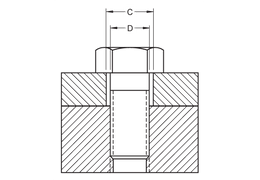
CLEARANCE HOLE CHART
Clearance hole chart for inch bolts and screws according to ASME B18.2.8
Read more

Paint Formulation
Paint consists of four basic components:
Resin
Pigment
Solvent
Additives
The performance of a coating is influenced...
Read more
Viscosity Conversion
Viscosity Conversion table comparing some of the typical viscosity scales used in Paint and Coatings including:...
Read more
Latest comments
-
 MalcomizingWe have a customer that needs parts Malcomized, could you...
 -
electricianGreat technical overview! This blog clearly explains...
-
electricianClear overview of different electrical service types and...
-
Blade to mix sand into paintUsed to have a Teflon on plastic blade need one for my...
-
cpvc & paint mix formulavery good excellent OK
Featured posts
Morehouse Cowles Sunset – DisperseTech Offers Compatible Impeller Blades
With the sunset of Morehouse Cowles, DisperseTech now offers compatible impeller blades for legacy mixers. Customers...
Read more
Unleashing the Power of Dispersion Blades: A Comprehensive Guide to Enhanced Mixing Efficiency
In the dynamic world of mixing processes, the efficiency of your equipment can make or break your operations. Enter...
Read more
CLEARANCE HOLE CHART
Clearance hole chart for inch bolts and screws according to ASME B18.2.8
Read more
Blog tags
No featured images
Archived posts
Top authors
Defining Hazardous Areas
DEFINING HAZARDOUS AREAS
Today’s modern chemical facilities often contain both flammable gases and ignitable dust, which pose explosion risks. To prevent explosions from happening in harsh environments whereby flammable gases or combustible dusts are present directives and guidelines are put in place to protect both the public, workforce, and environment. Both the USA and the European Union have their certifications and guidelines to control the risks from dangerous substances igniting.
What is an explosive atmosphere?
According to The Dangerous Substances and Explosive Atmospheres Regulations, commonly known as DSEAR, an explosive atmosphere is defined by a mixture of dangerous substances within the air under atmospheric conditions. The atmospheric conditions are most commonly referred to their ambient temperatures and pressures, for example, a temperature of –20°C to 40°C and pressure of 0.8 to 1.1 bar. Three components are necessary for an explosion to occur:
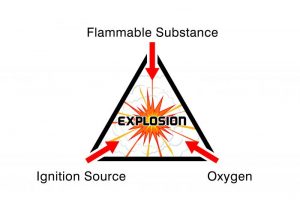
- Flammable Substance – This needs to be present in a relatively high quantity to produce an explosive mixture (e.g. gas, vapors, mists and dusts).
- Oxygen – Oxygen is required in high quantities and in combination with the flammable substance to produce an explosive atmosphere.
- Ignition Source – A spark or high heat must also be present.
Where can an explosive atmosphere be found?
An explosive atmosphere can be found in both public spaces and within the workplace across many different types of industries. An example of an explosive atmosphere whereby flammable gases or vapors are present would be a fueling station. An example of an explosive atmosphere whereby organic dusts such as grain flour or wood would be a timber sawmill.
Understanding Explosive Atmospheres
Protecting the public, workforce, and environment from explosive atmospheres is paramount but not a universal standard. Both the USA and the European Union have similar standards but are defined slightly different from each other.
In the US, NEC (National Electric Code) is followed, which puts HAZLOC (Hazardous Locations) into classes, divisions (and groups for the type of materials present) and for Europe, IEC (International Electrotechnical Commission) classifies HAZLOC by zones. Products such as a panel PC will then be certified to be safe in these areas before they can be applied.
In North America products are listed by UL (Underwriters Laboratories, a global safety consulting and certification company based in the US and 45 other countries) under what level of Class and Division the product is suitable for, whilst ATEX uses certified bodies to classify products for use in the EU.
Outside of the European Union, regulations apply under the IEC Ex (International Electrotechnical Commission – System for Certification to Standards Relating to Equipment for Use in Explosive Atmospheres). IEC Ex is a voluntary system that provides an internationally accepted means of proving compliance with IEC standards. IEC standards are used in many national approval schemes and as such, IEC Ex certification can be used to support national compliance, negating the need in most cases for additional testing.
Intrinsic Safety Barriers

UL Classes for Ignitable Substance
- Class 1 Flammable gas, vapors, and liquids.
- Class 2 Combustible dusts.
- Class 3 Ignitable fibers and flyings.
Group Ratings – Groups are used to define substances by rating their explosive or ignitable nature, in relation to other known substances.
UL Divisions for Operating Conditions – Divisions go further in classifying how often the flammable or explosive substances are likely to be present under normal operating conditions.
- Division 1 Flammable substances are continually present or are likely to exist under normal operating conditions.
- Division 2 Flammable substances are not likely to exist under normal operating conditions.
ATEX Directives and Certifications
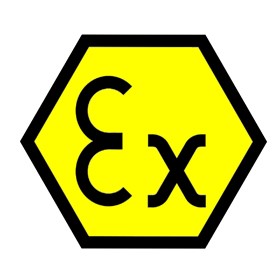
The abbreviation ATEX is derived from the French words, ATmosphères EXplosibles and represents 2 European directives stipulated for controlling explosive atmospheres:
- Directive 99/92/EC (also known as ‘ATEX 137’ or the ‘ATEX Workplace Directive’) on minimum requirements for improving the health and safety protection of workers potentially at risk from explosive atmospheres.
- Directive 94/9/EC (also known as ‘ATEX 95’ or ‘the ATEX Equipment Directive’) on the approximation of the laws of Members States concerning equipment and protective systems intended for use in potentially explosive atmospheres.
ATEX classifications are in zones, derived from the US ‘HAZLOC’ standard. They combine the ‘Class’ area classification and the ‘Division’ likelihood of explosive substance presence. It subdivides powders and dust from gases and vapors.
ATEX directives and certifications for gasses, vapors and mists
ATEX Zone 0 A place in which an explosive atmosphere consisting of a mixture with air of dangerous substances in the form of gas, vapor, or mist is present continuously or for long periods or frequently.
ATEX Zone 1 A place in which an explosive atmosphere consisting of a mixture with air of dangerous substances in the form of gas, vapor, or mist is likely to occur in normal operation occasionally.
ATEX Zone 2 A place in which an explosive atmosphere consisting of a mixture with air of dangerous substances in the form of gas, vapor, or mist is not likely to occur in normal operation but, if it does occur, will persist for a short period only.
ATEX directives and certifications for combustible dusts
ATEX Zone 20 A place in which an explosive atmosphere in the form of a cloud of combustible dust in air is present continuously, or for long periods or frequently.
ATEX Zone 21 A place in which an explosive atmosphere in the form of a cloud of combustible dust in air is likely to occur in normal operation occasionally.
ATEX Zone 22 A place in which an explosive atmosphere in the form of a cloud of combustible dust in air is not likely to occur in normal operation but, if it does occur, will persist for a short period only.
Comparing UL Classes and Divisions with ATEX Directives
Class 1 / Division 1 :: Zone 0 & Zone 1
Where ignitable concentrations of flammable gases, vapors, or liquids:
- Are likely to exist under normal operating conditions.
- Exist frequently because of maintenance and repair work or frequent equipment failure.
Class 1 / Division 2 :: Zone 2 Where ignitable concentrations of flammable gases, vapors, or liquids:
- Are not likely to exist under normal operating conditions.
- Are normally in closed containers where the hazard can only escape through accidental rupture or breakdown of such containers or in case of abnormal operation of equipment.
Posted in:
Electrical
Leave a comment
Related posts
 What to consider when moving to an Inverter
Inverters offer many benefits over traditional mechanical drives with fewer moving parts, larger speed ranges,...
Read more
Electrical Service Types and Voltages
In commercial and industrial applications, voltages can be in excess of 1000kV. Most equipment supplied by...
Read more
Equipment in Hazardous (classified) Locations
The need to place general-purpose equipment in hazardous (classified) locations is not new, yet in the last three...
Read more
Purged Cabinets and Enclosure Protection Systems
In 1967, the NFPA Technical Committee on Electrical Equipment in Chemical Atmospheres established recommended...
Read more