With the sunset of Morehouse Cowles, DisperseTech now offers compatible impeller blades for legacy mixers. Customers...

Search in blog
Blog categories
Latest posts
Morehouse Cowles Sunset – DisperseTech Offers Compatible Impeller Blades
Read more

Unleashing the Power of Dispersion Blades: A Comprehensive Guide to Enhanced Mixing Efficiency
Read more
In the dynamic world of mixing processes, the efficiency of your equipment can make or break your operations. Enter...
Popular posts

Properties of Common Solvents
Density, boiling point, evaporation rate, and flash point of common solvents
Read more

Tip Speed Definition and Formula
Blade Speed (tip speed), measures how far a point on the outer most edge of the disperser blade travels in a given...
Read more
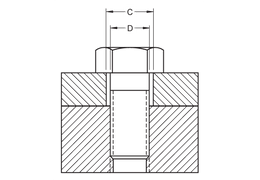
CLEARANCE HOLE CHART
Clearance hole chart for inch bolts and screws according to ASME B18.2.8
Read more

Paint Formulation
Paint consists of four basic components:
Resin
Pigment
Solvent
Additives
The performance of a coating is influenced...
Read more
Viscosity Conversion
Viscosity Conversion table comparing some of the typical viscosity scales used in Paint and Coatings including:...
Read more
Latest comments
-
 MalcomizingWe have a customer that needs parts Malcomized, could you...
 -
electricianGreat technical overview! This blog clearly explains...
-
electricianClear overview of different electrical service types and...
-
Blade to mix sand into paintUsed to have a Teflon on plastic blade need one for my...
-
cpvc & paint mix formulavery good excellent OK
Featured posts
Morehouse Cowles Sunset – DisperseTech Offers Compatible Impeller Blades
With the sunset of Morehouse Cowles, DisperseTech now offers compatible impeller blades for legacy mixers. Customers...
Read more
Unleashing the Power of Dispersion Blades: A Comprehensive Guide to Enhanced Mixing Efficiency
In the dynamic world of mixing processes, the efficiency of your equipment can make or break your operations. Enter...
Read more
CLEARANCE HOLE CHART
Clearance hole chart for inch bolts and screws according to ASME B18.2.8
Read more
Blog tags
No featured images
Archived posts
Top authors
Purged Cabinets and Enclosure Protection Systems
Pressurization Standards
Committee SP12 of the Instrument Society of America (ISA) established the first Design Standard in 1966, entitled "ISA s12.4 - Instrument Purging For Reduction Of Hazardous Area Classification." In 1967, the NFPA Technical Committee on Electrical Equipment in Chemical Atmospheres established recommended practices, entitled "NFPA 496 - Purged and Pressurized Enclosures for Electrical Equipment." Since then, the NFPA has expanded their document by adding recommendations for enclosure ventilation and dilution.
Pressurization "Types"
The NFPA and ISA define "Types" of pressurization based on the Division rating of a hazardous location and electrical ratings of the protected equipment. General-purpose and Division 2 rated electrical equipment require different means of protection, depending on their location. Type "X" Protects general-purpose equipment in Division 1 Areas. This system reduces the classification within protected enclosures from Division 1 to non-hazardous. It is required to automatically control electrical power to all protected equipment. Type "Y" Protects Division 2 rated equipment in Division 1 Areas. This system reduces the classification within protected enclosures from Division 1 to Division 2. All protected equipment must be rated for Division 2. Automatic power control disconnects are not required, but visual and/or audible alarms must be initiated when there is a loss of pressure. Type "Z" Protects general-purpose equipment in Division 2 Areas. This system reduces the classification within protected enclosures from Division 2 to non-classified. Automatic power control disconnects are not required, but visual and/or audible alarms must be initiated when there is a loss of pressure.
Purging and Pressurizing Methods
The NFPA and ISA define several techniques for protecting equipment. Most equipment requires only basic pressurization in Class II areas or purging in Class I areas. Ventilation and dilution are advanced protection methods for heat-producing or flammable gas analyzing equipment.
Purging Common equipment in Class I Areas
As strictly defined by NFPA 496, this method is a start-up process of Class I area pressurizing which removes flammable vapors from a protected enclosure. This is accomplished by exchanging a known volume of protective gas while maintaining a minimum positive enclosure pressure of 0.10 inches (2.5 mm) of water. The 2003 edition of NFPA 496 recommends 4 volume exchanges for all enclosures and 10 volume exchanges for all motors.
Pressurization Common equipment in Class I & II Areas
This method prevents the entrance of flammable gas or combustible dust into protected enclosures. In Class II areas, this is accomplished by manually removing any dust and then applying a protective gas supply to maintain a positive enclosure pressure of 0.50 inches (12.7 mm) of water. In Class I areas, this is accomplished by "purging" as defined below, and by then maintaining a minimum positive enclosure pressure of 0.10 inches (2.5 mm) of water. Power can then be applied to the protected equipment under conditions established by the Division rating.
Ventilation Hot equipment in Class I & II Areas
This method provides protection as outlined above and also removes or dissipates heat from electrical devices within a protected enclosure. This method is commonly used to cool equipment or reduce enclosure surface temperatures. Ventilation requires high airflow and is commonly performed with blowers for high voltage switchgear devices.
Dilution Analytical equipment in Class I Areas
This method provides protection as outlined above and continuously removes or dissipates flammable gases within a protected enclosure. Dilution may require the use of nitrogen to blanket the enclosure. Otherwise, a higher flow of instrument air will likely be required.
FAQ
What is purging?
Purging is the process of supplying enclosures with compressed air or inert gas at the proper flow and pressure in order to reduce the hazardous gas inside the enclosure to a safe level. Pressurization is the process of bringing compressed air or inert gas within an enclosure to a pressure where there is no ingress of hazardous gasses or combustible gas. Both purging and pressurization are required in a Class I, gas atmosphere. Only pressurization is required in a Class II, dust atmosphere.
What is used to purge/pressurize?
The most common and practical protective gas is compressed instrument quality air that contains no more than trace amounts of combustible vapor. Inert gases, such as nitrogen or argon, are acceptable. Although they are usually expensive and impractical, they may be required for some gas analysis applications.
What is the pressure requirement?
Most purging applications require a minimum enclosure pressure of 0.10 inches (2.5 mm) of water. One psi is equal to 27.7 inches of water. In some circumstances, a minimum enclosure pressure of 0.50 inches (12.7 mm) of water is required to protect against ignitable dust. However, in all cases, a higher enclosure pressure should be maintained to create a reasonable safety factor. In rare circumstances, enclosure pressures as high as 2.5 inches (63.5 mm) of water may be required to offset sudden atmospheric pressure fluctuations, such as those created near missile launching or off-shore drilling platforms.
How much purging gas is used?
Average protective gas consumption during pressurization at a 0.10 inch (2.5 mm) enclosure pressure should fall somewhere between 0.1 to 3.5 SCFH per cubic foot (2.83 to 99.11 l/hr) of enclosure volume. However, use will depend on the protected enclosure's integrity and normal pressure setting. Use is also dependent on the quantity and size of covers and doors as well as devices which penetrate the surface. Advanced forms of protection such as cooling or dilution may require continuous flow rates of 30 to 100 SCFH (849.38 to 2831.26 l/m). Purging requires a much higher flow rate than pressurization, but only for a short period of time.
What kinds of enclosures can be purged?
Any enclosure can be purged, but enclosures featuring gasketing and multiple door fasteners are ideal. Therefore, in the absence of official construction requirements for purged enclosures, we recommend enclosures which meet or exceed the National Electrical Manufacturer’s Association rating of NEMA 4 or NEMA 12.
What kinds of devices can be purged?
Virtually any basic electrical device can be purged, if all "live" or energized components can be isolated from the surrounding environment. Devices such as pushbuttons, relays, timers and programmable controllers only need to be installed in a sealed enclosure. Motors only require a totally enclosed housing.
How can the equipment be accessed?
Equipment mounted in the protected enclosure can be accessed if the area is known to be non-hazardous, or if all power to the protected equipment has been de-energized. In other words, internal equipment should be treated as if located in an explosion-proof enclosure. However, a cooling period may be required before accessing hot components, such as transformers or variable speed drives, which would otherwise be unacceptable for use in the hazardous location. Equipment mounted through the surface of a protected enclosure may require a sealed access door if the equipment is not suitable for exposure to the surrounding atmosphere. Advanced pressurization systems, like Rapid Exchange Purging Systems can maintain a positive pressure, by increasing the flow of protective gas while the access door is open.
Posted in:
Electrical
Leave a comment
Related posts
 What to consider when moving to an Inverter
Inverters offer many benefits over traditional mechanical drives with fewer moving parts, larger speed ranges,...
Read more
Electrical Service Types and Voltages
In commercial and industrial applications, voltages can be in excess of 1000kV. Most equipment supplied by...
Read more
Equipment in Hazardous (classified) Locations
The need to place general-purpose equipment in hazardous (classified) locations is not new, yet in the last three...
Read more
Defining Hazardous Areas
Today’s modern chemical facilities often contain both flammable gases and ignitable dust, which pose explosion risks....
Read more