With the sunset of Morehouse Cowles, DisperseTech now offers compatible impeller blades for legacy mixers. Customers...

Blog navigation
Search in blog
Blog categories
Latest posts
Unleashing the Power of Dispersion Blades: A Comprehensive Guide to Enhanced Mixing Efficiency
07/25/2025
Read more
Posted in:
Mixing and Dispersion
1336
views
0
Liked
In the dynamic world of mixing processes, the efficiency of your equipment can make or break your operations. Enter...
Keyway Chart
03/11/2024
Read more
Posted in:
Mixing and Dispersion
8371
views
0
Liked
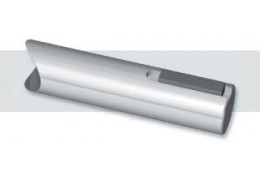
The following tables show standard dimensions for keys and their grooves.
Popular posts
Properties of Common Solvents
07/19/2014
78778
views
4
comments
0
Liked
Density, boiling point, evaporation rate, and flash point of common solvents
Read more
Tip Speed Definition and Formula
10/16/2012
64464
views
3
comments
0
Liked
Blade Speed (tip speed), measures how far a point on the outer most edge of the disperser blade travels in a given...
Read more
Paint Formulation
10/19/2020
Posted in:
Paint and Coatings
37089
views
6
comments
0
Liked
Paint consists of four basic components:
Resin
Pigment
Solvent
Additives
The performance of a coating is influenced...
Read more
CLEARANCE HOLE CHART
06/20/2022
Posted in:
Tables and Conversions
30693
views
0
Liked
Clearance hole chart for inch bolts and screws according to ASME B18.2.8
Read more
Viscosity Conversion
11/06/2021
21280
views
0
Liked
Viscosity Conversion table comparing some of the typical viscosity scales used in Paint and Coatings including:...
Read more
Featured posts
Morehouse Cowles Sunset – DisperseTech Offers Compatible Impeller Blades
10/11/2025
Posted in:
Mixing and Dispersion
1957
views
0
Liked
With the sunset of Morehouse Cowles, DisperseTech now offers compatible impeller blades for legacy mixers. Customers...
Read more
Unleashing the Power of Dispersion Blades: A Comprehensive Guide to Enhanced Mixing Efficiency
07/25/2025
Posted in:
Mixing and Dispersion
1336
views
0
Liked
In the dynamic world of mixing processes, the efficiency of your equipment can make or break your operations. Enter...

Read more
Keyway Chart
03/11/2024
Posted in:
Mixing and Dispersion
8371
views
0
Liked
The following tables show standard dimensions for keys and their grooves.
Read more
CLEARANCE HOLE CHART
06/20/2022
Posted in:
Tables and Conversions
30693
views
0
Liked
Clearance hole chart for inch bolts and screws according to ASME B18.2.8
Read more
Blog tags
Photo gallery
No featured images
Archived posts
Top authors
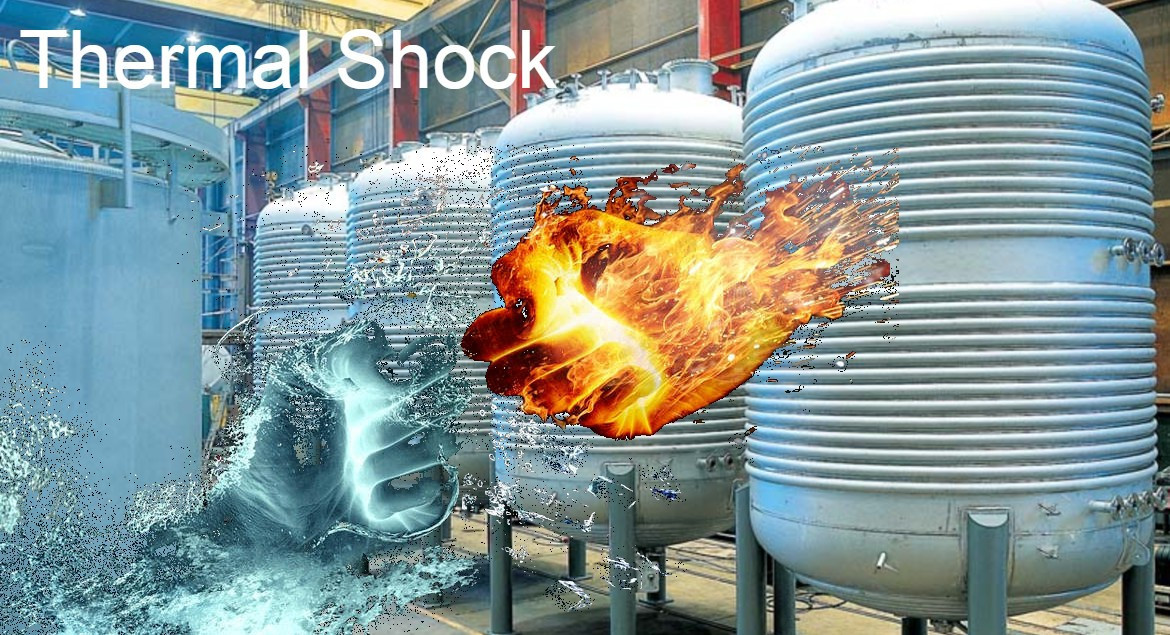
JACKETED TANKS AND THERMAL SHOCK

Jacketed tanks/reactors are commonplace in the chemical industry. Many batch operations in the chemical industry require both heating and cooling at different times in the process. Rapid changes in temperature of the heat transfer media can thermally shock the equipment. Typically, thermal shock is defined as changing the cooling or heating media at the jacket inlet more than 25 F per minute. Thermal shock can be avoided by tempering the heat transfer media and providing proper venting. Tempering is easiest achieved when a common heat transfer media is used for both heating and cooling. A Temperature Control Unit (TCU) can be used to adjust the temperature of the heat transfer media at a rate that does not pose the risk of thermal shock. While TCUs are the simplest means of controlling temperature and protecting equipment many companies still insist on using different media for heating and cooling. Many times this includes steam heat and water cooling. If this MUST be done some minimum precautions should be taken.
1. HEATING to COOLING:
When changing from steam heating to cooling water one of the following procedures should be followed:
A. Forced Tempering
Vent steam out of jacket and drain condensate. Allow jacket cool down naturally or use compressed air to blow-down the jacket from top to bottom to achieve correct temperatures. Close vents and slowly introduce hot water at the correct temperature to the jacket. Increase flow rate to process conditions and decrease water temperature at a rate of less than 25 F per minute.
B. Natural Tempering
Vent steam out of jackets and completely drain all condensate. Allow the jacket to cool down naturally to the correct temperature. Close vents and introduce cooling water.
2. COOLING to HEATING:
When changing from cooling water to steam heating one of the following procedures should be followed:
A. Forced Tempering
Raise circulating water temperature in the jacket at a rate of less than 25 F per minute until desired steam temperature is reached. Vent jackets and completely drain out water. Close vents and slowly introduce steam into the jacket.
B. Natural Tempering
Vent and drain water out of jackets. Let the jacket warm up naturally to the correct temperature. Slowly introduce steam into jackets at reduced pressure and/or flow rate (temperature) until the desired steam temperature is reached. As with any manual process, there are risks associated with this.
Latest posts
Morehouse Cowles Sunset – DisperseTech Offers Compatible Impeller Blades
10/11/2025
Read more
Posted in:
Mixing and Dispersion
1957
views
0
Liked
With the sunset of Morehouse Cowles, DisperseTech now offers compatible impeller blades for legacy mixers. Customers...
Unleashing the Power of Dispersion Blades: A Comprehensive Guide to Enhanced Mixing Efficiency
07/25/2025
Read more
Posted in:
Mixing and Dispersion
1336
views
0
Liked
In the dynamic world of mixing processes, the efficiency of your equipment can make or break your operations. Enter...
Keyway Chart
03/11/2024
Read more
Posted in:
Mixing and Dispersion
8401
views
0
Liked
The following tables show standard dimensions for keys and their grooves.
Popular posts
Properties of Common Solvents
07/19/2014
78798
views
4
comments
0
Liked
Density, boiling point, evaporation rate, and flash point of common solvents
Read more

Tip Speed Definition and Formula
10/16/2012
64465
views
3
comments
0
Liked
Blade Speed (tip speed), measures how far a point on the outer most edge of the disperser blade travels in a given...
Read more

Paint Formulation
10/19/2020
Posted in:
Paint and Coatings
37091
views
6
comments
0
Liked
Paint consists of four basic components:
Resin
Pigment
Solvent
Additives
The performance of a coating is influenced...
Read more
CLEARANCE HOLE CHART
06/20/2022
Posted in:
Tables and Conversions
30715
views
0
Liked
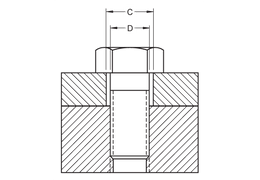
Clearance hole chart for inch bolts and screws according to ASME B18.2.8
Read more
Related products
Leave a comment
Related posts

What to consider when moving to an Inverter
04/02/2021
3029
views
0
Liked
Inverters offer many benefits over traditional mechanical drives with fewer moving parts, larger speed ranges,...
Read more
Dual-Axis Centrifugal Mixer - A Better Mix
Posted in:
Mixing and Dispersion
09/20/2020
6089
views
0
Liked
Review of the function and operation of planetary-centrifugal mixers. Published July 2010, Adhesives and Sealants...
Read more
Disperser Blade Mounting
Posted in:
Mixing and Dispersion
09/18/2014
3590
views
0
Liked
To transfer torque from the shaft to the blade, manufacturers use a number of configurations. The two most common are...
Read more
Tank Cleaning Equipment Choices
02/07/2017
2356
views
0
Liked
Cleaning Process tanks used in the manufacture of high viscosity products and products that are not dissolved by the...
Read more
DISPERSER CONFIGURATION
Posted in:
Mixing and Dispersion
11/06/2021
11083
views
0
Liked
The design of a dispersion system begins by defining the batch size and product characteristics. From there we can...
Read more

Latest comments