With the sunset of Morehouse Cowles, DisperseTech now offers compatible impeller blades for legacy mixers. Customers...

Search in blog
Blog categories
Latest posts

Morehouse Cowles Sunset – DisperseTech Offers Compatible Impeller Blades
Read more

Unleashing the Power of Dispersion Blades: A Comprehensive Guide to Enhanced Mixing Efficiency
Read more
In the dynamic world of mixing processes, the efficiency of your equipment can make or break your operations. Enter...

Popular posts

Properties of Common Solvents
Density, boiling point, evaporation rate, and flash point of common solvents
Read more

Tip Speed Definition and Formula
Blade Speed (tip speed), measures how far a point on the outer most edge of the disperser blade travels in a given...
Read more

Paint Formulation
Paint consists of four basic components:
Resin
Pigment
Solvent
Additives
The performance of a coating is influenced...
Read more
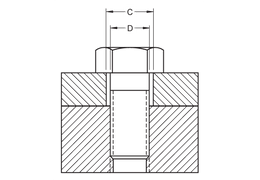
CLEARANCE HOLE CHART
Clearance hole chart for inch bolts and screws according to ASME B18.2.8
Read more
Viscosity Conversion
Viscosity Conversion table comparing some of the typical viscosity scales used in Paint and Coatings including:...
Read more
Featured posts
Morehouse Cowles Sunset – DisperseTech Offers Compatible Impeller Blades
With the sunset of Morehouse Cowles, DisperseTech now offers compatible impeller blades for legacy mixers. Customers...
Read more
Unleashing the Power of Dispersion Blades: A Comprehensive Guide to Enhanced Mixing Efficiency
In the dynamic world of mixing processes, the efficiency of your equipment can make or break your operations. Enter...
Read more
CLEARANCE HOLE CHART
Clearance hole chart for inch bolts and screws according to ASME B18.2.8
Read more
Blog tags
Photo gallery
No featured images
Archived posts
Top authors

Tip Speed Definition and Formula
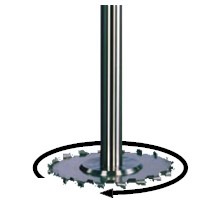
Circumference = Π × D
So if we take a 1 foot diameter (D) blade and turn it one complete revolution, a point on its edge would have travelled pi (Π) 3.14 feet.
By multiplying by rpm (n) we get the Tip Speed formula:
TipSpeed = Π × D × n
where:- Tip Speed - impeller tip speed (rpm)
- D - impeller diameter (ft)
- n - impeller rotation speed (fpm)
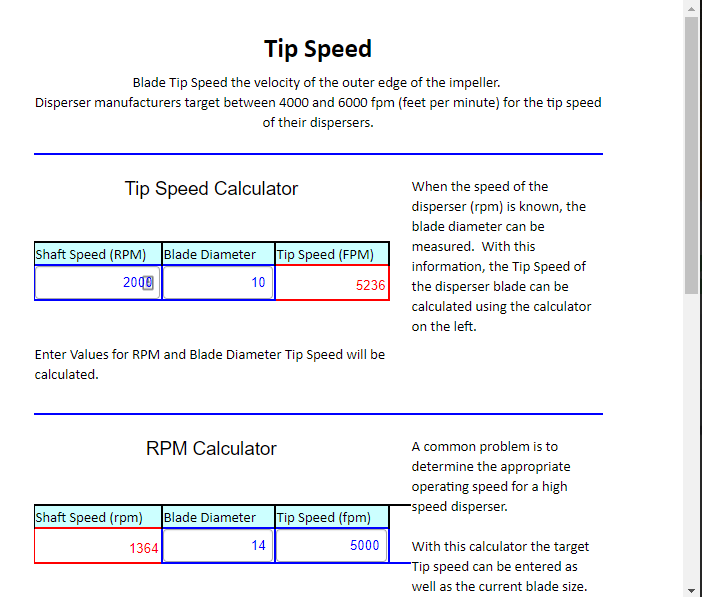
Tip Speed Calculator
Calculators for Tip Speed, RPM, and Scale-up
Leave a comment
Comments
-
Oil emulsions
By: Carl austin On 05/08/2025We mix 2000l of oil emulsion with fungicides upto 8k
Is th blade diameter the diameter of the tank or the actual blade one is 140 cm or. 12 cm can submit photos please advise DOLE FRUIT COMPANYReplied by: Steve Schmidt On 07/27/2025
-
Best Products in India
By: Ceracin On 11/21/2023Thanks for sharing this amazing blog.
-
Tip speed calculation
By: Vijay kumar On 02/09/2023Tip speed = Pi*r*h
Pi = Area of circumference
r = radius
h = height of the RMG or Blender from bottom to top of till filling of materials
is it right.Replied by: Presta Admin On 02/09/2023
Related posts
 What to consider when moving to an Inverter
Inverters offer many benefits over traditional mechanical drives with fewer moving parts, larger speed ranges,...
Read more
Dual-Axis Centrifugal Mixer - A Better Mix
Review of the function and operation of planetary-centrifugal mixers. Published July 2010, Adhesives and Sealants...
Read more
JACKETED TANKS AND THERMAL SHOCK
Rapid changes in temperature of the heat transfer media can thermally shock the equipment. Typically, thermal shock...
Read more
UNDERSTANDING NET WEIGHT FILLER CONFIGURATION AND PERFORMANCE
UNDERSTANDING NET WEIGHT FILLER CONFIGURATION AND PERFORMANCE - Nozzles, Products Supply, Product Delivery, conveying...
Read more
Disperser Blade Mounting
To transfer torque from the shaft to the blade, manufacturers use a number of configurations. The two most common are...
Read more
Latest comments