With the sunset of Morehouse Cowles, DisperseTech now offers compatible impeller blades for legacy mixers. Customers...

Search in blog
Blog categories
Latest posts
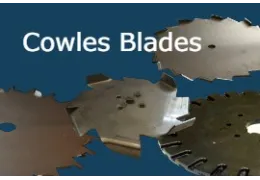
Morehouse Cowles Sunset – DisperseTech Offers Compatible Impeller Blades
Read more
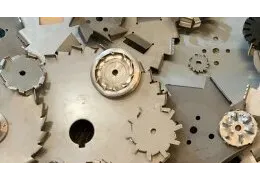
Unleashing the Power of Dispersion Blades: A Comprehensive Guide to Enhanced Mixing Efficiency
Read more
In the dynamic world of mixing processes, the efficiency of your equipment can make or break your operations. Enter...

Popular posts

Properties of Common Solvents
Density, boiling point, evaporation rate, and flash point of common solvents
Read more

Tip Speed Definition and Formula
Blade Speed (tip speed), measures how far a point on the outer most edge of the disperser blade travels in a given...
Read more

Paint Formulation
Paint consists of four basic components:
Resin
Pigment
Solvent
Additives
The performance of a coating is influenced...
Read more
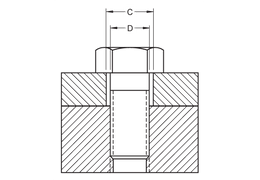
CLEARANCE HOLE CHART
Clearance hole chart for inch bolts and screws according to ASME B18.2.8
Read more
Viscosity Conversion
Viscosity Conversion table comparing some of the typical viscosity scales used in Paint and Coatings including:...
Read more
Featured posts
Morehouse Cowles Sunset – DisperseTech Offers Compatible Impeller Blades
With the sunset of Morehouse Cowles, DisperseTech now offers compatible impeller blades for legacy mixers. Customers...
Read more
Unleashing the Power of Dispersion Blades: A Comprehensive Guide to Enhanced Mixing Efficiency
In the dynamic world of mixing processes, the efficiency of your equipment can make or break your operations. Enter...
Read more
CLEARANCE HOLE CHART
Clearance hole chart for inch bolts and screws according to ASME B18.2.8
Read more
Blog tags
Photo gallery
No featured images
Archived posts
Top authors

Dispersion Blade Designs
Dispersion Blade Designs
Stainless Steel Single Piece Blades
Most dispersion blades are formed from a circular disk of material, typically 304 stainless steel. Teeth are formed around the perimeter of the disk by cutting slits into the disk and bending the resulting tabs.
Group 1 (Hockmeyer Style Blades)
Our oldest and most popular styles. Formed from a single piece of stainless steel with different profiles to adjust levels of shear and flow.
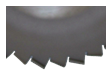
F Blade "Sawtooth"
The F blade is the standard shear bade in this group. Uniform teeth accelerate pigment particles and breakup agglomerates. High shear is quickly achieved with turbulent flow.
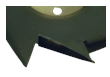
G Blade "Pumper"
High-vaned "Pumper" blade is designed for maximum turbulent flow while still producing shear.
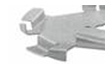
E Blade "Cutter"
Superior for dissolving resins, dispersing fibrous materials and in high vehicle viscosities and/or solids loadings applications. Produces shear but with more turbulence than other designs.
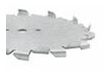
K Style "Clipped"
Similar to the F blade, the K blade features a reduced blade surface. It requires less horsepower and is gerally used in operations where the available horsepower is borderline for the batch size.
Group 2 (Cowles Style Blades)
Originally offered as competitive offsets to those Blades offered by Cowles.
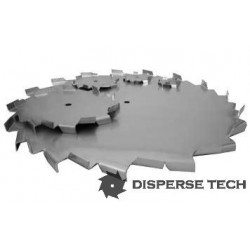
HS Blade - "Cowles Blade"
The HS series dispersion blade is a variation of the standard saw tooth blade. It is often referred to as a Cowles blade. Like the F Blade, it features alternating teeth.
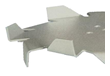
H Style "Hi Vane"
Another excellent high flow, low shear impeller. Great for blending and agitation.
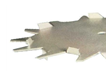
I Style "Pick"
High viscosities / high solids impeller, produces shear with increased turbulence.
Group 3 (Louvered Blades)
A variation on the disperser blade is the louvered or vented impeller. These are similarly formed from a flat disk of material and may also include teeth. However, inside the flat center area, louvers or vents are formed, by cutting a slot and bending or cupping the material around the slot. These louvers serve to introduce an axial (down along the shaft) component to the flow.
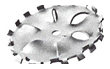
R - "ITT" Intensive Type with Teeth
The Conn ITT provides high shear and agitation. It offers a good combination of material movement shear.
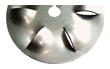
Q - "IT" Intensive Type Blade
The Conn IT produces positive but gentle material flow; Low shear smooth fast mixing without air inclusion.
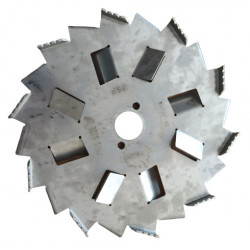
X - "HSXP" Blade
The HSXP blade features serrated teeth and also includes alternating fins or vents in the center of the impeller to help pump the material through the blade.
Group 4 (Axial Flow Blades)
While not as efficient as propellers or pitched Blade turbines, these blades provide the most axial flow of any dispersion blade.
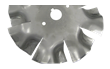
S Blade "ITC" Intensive Type Cutter
The Conn ITC has large pitched teeth on the periphery instead of louvers providing a high degree of pumping.
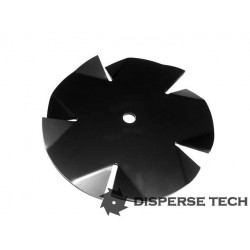
PMP Blade
The PMP series impellers are designed primarily for blending, mixing, and general agitation. The PMP series blade is designed similar to a fan blade so that your batch is moved around the tank with minimal shear.
Multi Piece Fabricated Blades
Group 5 (Ring Blades)
Another more radical configuration uses a series of annular surfaces or rings to shear material flowing through spaces between them. While previous designs were formed from a single piece of material, these impellers are fabricated from several pieces of material, machined and/or formed to a specific profile, and finally assembled into the finished impeller.
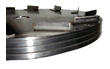
C - "CSI" Constant Shear Impeller
Product accelerates through a series of rings machined to produce venturi. Yields very fine grinds with laminar flow and less heat build-up.
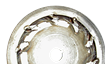
D - "Ring" Blade
Product passes through a series of curved rings to produce fine grinds, laminar flow, and low heat.
Polymer Blades
Group 5 (Poly Blades)
In an effort to improve wear, polymer blades were developed. These impellers produce superior wear resistance in certain applications. As forming teeth in these materials is quite difficult, grooves are machined and/or cast into the impeller to provide the pumping and impingement surfaces.
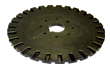
P Type "Polyblade"
Manufactured from Ultra-High Molecular Weight Polyethylene (UHMP) for superior wear. Effective in highly abrasive applications with no metal contamination.
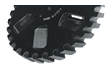
O - Conn "Poly-ITT"
UHMW version of the ITT. Good combination of material movement and shear.
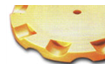
N - Norstone "Urethane" Impeller
Urethane blade provides excellent wear resistance.
Posted in:
Mixing and Dispersion
Leave a comment
Related posts
 What to consider when moving to an Inverter
Inverters offer many benefits over traditional mechanical drives with fewer moving parts, larger speed ranges,...
Read more
Dual-Axis Centrifugal Mixer - A Better Mix
Review of the function and operation of planetary-centrifugal mixers. Published July 2010, Adhesives and Sealants...
Read more
JACKETED TANKS AND THERMAL SHOCK
Rapid changes in temperature of the heat transfer media can thermally shock the equipment. Typically, thermal shock...
Read more
Disperser Blade Mounting
To transfer torque from the shaft to the blade, manufacturers use a number of configurations. The two most common are...
Read more
DISPERSER CONFIGURATION
The design of a dispersion system begins by defining the batch size and product characteristics. From there we can...
Read more
Latest comments